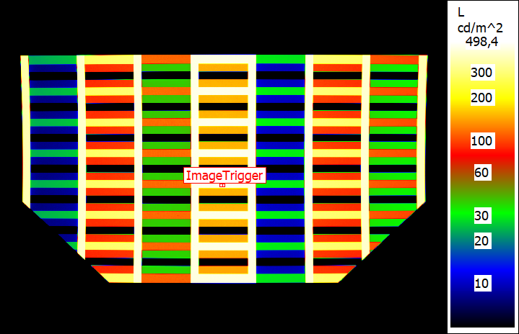
Dreistufiges Einbrennmuster für die Messung von Image-Sticking mit unserem Bildinhaltstrigger-Setup
LMK Sticking Image: Burn-in- & Image-Retention-Messung
Bildschatten, Geisterbilder und Burn-Ins sind kritische Faktoren für die Qualität und Haltbarkeit von Displays. Diese Effekte — auch als Image Retention oder Image Sticking bezeichnet — beeinträchtigen die Leistung, Lebensdauer und Bildqualität. Das LMK Sticking Image Add-on bietet eine präzise, standardisierte Methode zur Messung dieser Effekte und kann in bestehende Messabläufe integriert werden. LMK Sticking Image kann für LCDs und OLEDs sowie für andere Technologien verwendet werden, die anfällig für Bildschatten (Image Sticking) sind, insbesondere in Anwendungen mit statischen oder teilweise statischen Inhalten, z. B. im Automobilbereich oder im Bereich der öffentlichen Information.
Patentierte inhaltsbasierte Trigger- und Messmethodik
Alle LMK 5- und LMK 6-Systeme sind in der Lage, Image-Sticking-Testreihen durchzuführen. Ein zu testendes Display wird einer Einbrennphase mit definierten Mustern ausgesetzt, gefolgt von Relaxationsphasen, in denen die Helligkeitsverteilung aufgezeichnet wird.
In Verbindung mit einem LMK 6-System steht zusätzlich unser patentierter inhaltsbasierter Trigger. zur Verfügung. Die Kamera selbst beobachtet einen frei wählbaren Bereich des Einbrennbildes mit hoher Frequenz und detektiert optisch den exakten Zeitpunkt des Testbildwechsels. Dieser eindeutige Referenzzeitpunkt synchronisiert jede Relaxationsmessung mit den angezeigten Inhalten — unabhängig von Geräte-, Kabel- oder PC-spezifischen Eingangsverzögerungen — und ohne externe Photodioden- oder Triggerhardware. Diese Triggermethode im Image Sticking ist durch TechnoTeams internationale Patentfamilie (z.B. US 11,557,111 B2) geschützt.
Zwei- und dreistufige Bewertungsverfahren für zuverlässige Ergebnisse
Unser LMK Sticking Image Add-On kann zur Analyse des Einbrennverhaltens von Displays gemäß zwei etablierten Verfahren verwendet werden:

Einbrennmuster und Relaxationsbilder einer Three-level Messreihe
Three-level Ansatz von Dr. Lauer
- Kann auf Farb-Image-Sticking erweitert werden
- Die Methode wurde vom Deutschen Flachbildschirmforum (DFF) adaptiert
- Lokale oder zeitlich basierte Ungleichförmigkeitskorrektur möglich

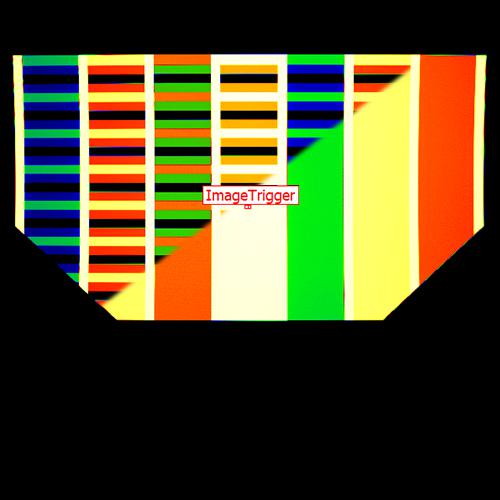
Einbrennmuster und Relaxationsbilder einer Two-level Messreihe
Two-level Ansatz von Dr. Bauer
- "Pattern rolling" in der Aufwärmphase
- Klassisches Schachbrettmuster in der Einbrennphase
- Zeitlich-basierte Ungleichförmigkeitskorrektur
Vorteile von LMK Sticking Image
- Schnelle und präzise Messung von Image-Retention-Effekten
- Patentgeschütztes Triggerverfahren für zuverlässige Synchronisation
- Flexible Auswertungsverfahren (zweistufig, dreistufig, benutzerdefinierte Einstellungen)
- Nahtlose Integration in bestehende LMK-Messaufbauten
- Übereinstimmung mit etablierten Standards der Displaymesstechnik durch DFF- und OEM-Verfahren
Integration und weiterführende Lösungen
LMK Sticking Image ist ein Teil des TechnoTeam Display Package und ist kompatibel mit anderen Lösungen unserer LMK-Systeme.
RELEVANTE PRODUKTE UND APPLIKATIONEN
Downloads
Publikationen
Concepts in Image Sticking Measurements: Temporal Alignment, Uniformity Correction and Grey Level Dependency
International Display Workshop 2020
This study introduces two proposed Image Sticking evaluation methods from the automotive industry and identifies relevant differences. It further focusses on the importance of precise temporal alignment and outlines the differences between temporal and local non-uniformity corrections as well as grey level dependency. The complete study bases on measured data.
Non-uniformity correction in recent automotive image sticking evaluation methods
SID Vehicle Displays & Interfaces 2019
Modern automotive displays may be sensitive to static content, which remains as an undesired effect of either temporary vanishing or being a static ghost image within the refreshed content. Therefore, there is a development of measurement procedures to quantize the degree of image sticking [1- 6]. Different aspects of these methods as the grey level dependencies or the importance of a temporal alignment were considered in [7]. But the mathematically necessary separation of unavoidable initial non-uniformities and the actual image sticking was excluded in that research.
This contribution concentrates on the performance of two selected image sticking evaluation methods [5, 6] from the automotive community and [1] for reference. After briefly introducing the three methods, this contribution focusses on their capability of separating initial non-uniformities from the actual sticking image effect of the target display. Therefore, a mathematical analysis, which is based on a simple but physically motivated sticking image model, is performed. Based on that, an additional non-uniformity correction is proposed. This additional correction has a positive influence on the precision but a negative influence on the measurement time of the fastest measurement method [6]. Thus, we propose a workflow, that decides based on the properties of the DUT whether the correction is necessary or not. All conclusions are supported by simulations and validated using measurement results of a randomly chosen non-uniform automotive LC display.
The aim of this paper is on the one hand to quantize the mathematical influence of the methods and on the other hand to suggest a workflow, which utilizes an existing method and optimizes its application with respect to precision and overall measurement time.
This contribution concentrates on the performance of two selected image sticking evaluation methods [5, 6] from the automotive community and [1] for reference. After briefly introducing the three methods, this contribution focusses on their capability of separating initial non-uniformities from the actual sticking image effect of the target display. Therefore, a mathematical analysis, which is based on a simple but physically motivated sticking image model, is performed. Based on that, an additional non-uniformity correction is proposed. This additional correction has a positive influence on the precision but a negative influence on the measurement time of the fastest measurement method [6]. Thus, we propose a workflow, that decides based on the properties of the DUT whether the correction is necessary or not. All conclusions are supported by simulations and validated using measurement results of a randomly chosen non-uniform automotive LC display.
The aim of this paper is on the one hand to quantize the mathematical influence of the methods and on the other hand to suggest a workflow, which utilizes an existing method and optimizes its application with respect to precision and overall measurement time.
Aspects of Image Sticking Evaluations Using Imaging Luminance Measurement Devices
Society for Information Display
Image Sticking is an undesired display property, which requires time-consuming and expensive testing. This study summarizes some proposed Image Sticking evaluation methods and identifies relevant differences. It derives aspects, which should be considered prior to a time-consuming and potentially irreversible Sticking Image measurement. Further, parameter analysis associated with the Imaging Luminance Measurement Device is briefly outlined.
- Typ:
- Add-On
- Anwendungen:
- Automotive Display Luftfahrt
- Messgröße:
- Lichtmessung
- Aufgaben:
- Entwicklung & Industrie