LMK 7 — 128
LMK 7-128 — 128 MP Imaging Luminance Measurement Device
The LMK 7-128 is TechnoTeam's flagship Imaging Luminance Measurement Device (ILMD) — a 128 MP monochrome camera with in-house V(λ)-matched photometric calibration, based on the Sony IMX661 CMOS sensor and connected via 10 GbE with Power over Ethernet. It is designed with a primary focus on in-line DeMura correction and high-resolution in-line inspection. Two operating modes cover both pixel-level display metrology and high-dynamic-range lighting applications.
New to ILMDs? See the LMK product overview for an introduction.
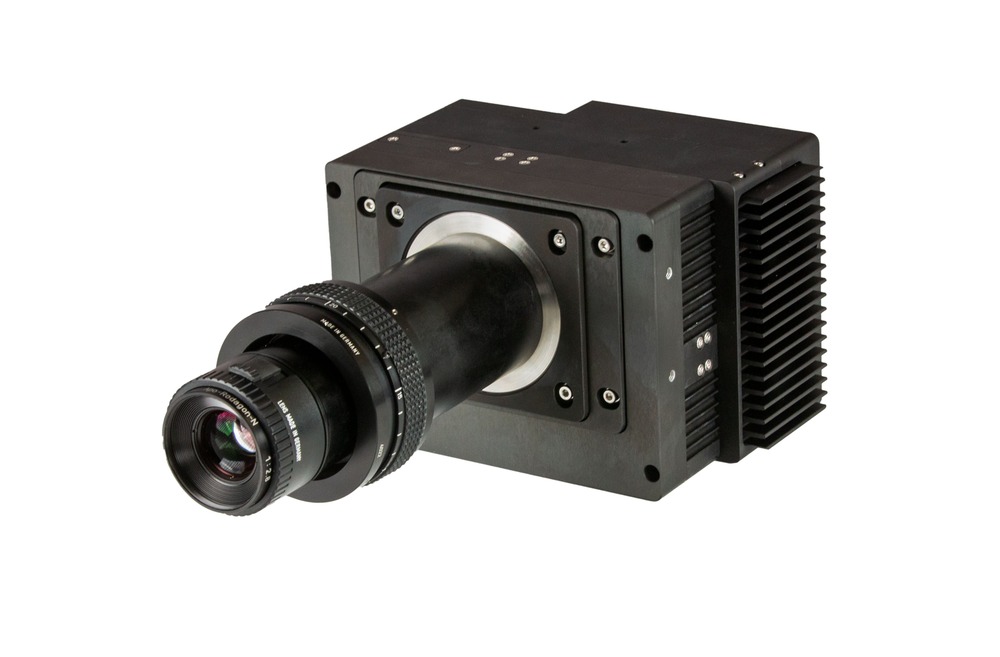
At a Glance
- V(λ)-matched photometric calibration as standard — on a 128 MP Sony IMX661 monochrome CMOS sensor; Type II (photometric + geometric) optional.
- Two operating modes — native 128 MP for pixel-level display metrology, binned mode (up to 32×32) for high-dynamic-range lighting and signal applications.
- In-line DeMura focus — designed for production-line use with the DeMura and LightChecker software; lab use with LabSoft on the same hardware.
- Advanced Pixel Registration (APR) + optional internal µShaking (±15 µm) — pixel-accurate measurements on fine-pitch OLED / µLED / Micro-LED panels.
- 10 GbE + PoE — combined data and power
- Interchangeable TechnoTeam optics — scattered-light-optimised for 128 MP.
- Hardware trigger — synchronised acquisition in automated setups.
Two Operating Modes and Supported Binning Factors
The LMK 7-128 supports native 128 MP read-out and several binning factors, selected per measurement task. The same housing and optical system are used in all modes, and each mode is photometrically calibrated independently: you can switch modes during a measurement session without re-calibration.
| Binning factor | Effective resolution | Typical use case |
|---|---|---|
| 1×1 (native) | 13 400 × 9 528 — ~128 MP | Pixel-level metrology on fine-pitch displays (OLED, µLED, Micro-LED). |
| 2×2 | 6 700 × 4 764 — ~32 MP | High-resolution lighting analysis, large display panels, moderate-brightness objects. |
| 4×4 | 3 350 × 2 382 — ~8 MP | High-sensitivity lighting inspection, signal lamps, HDR lighting scenes. |
| 8×8 | 1 675 × 1 191 — ~2 MP | Low-luminance regions in HDR scenes, large-area illumination mapping. |
| 16×16 | 838 × 596 — ~0.5 MP | Very low-luminance regions and rapid scanning scenarios. |
| 32×32 | 419 × 298 — ~0.12 MP | Extreme low-luminance HDR floors, fastest scanning and preview scenarios. |
A distinctive property of the LMK 7-128 is the large reserve of effective resolution that remains at high binning factors: with 128 MP as the starting point, 4×4 still delivers ~8 MP and 2×2 still delivers ~32 MP.
Why 128 Megapixels?
For high-resolution emitting objects — OLED, µLED, Micro-LED panels or structured light sources — the measurement camera must resolve each emitter with enough sampling to separate it cleanly from its neighbours. Aliasing between the emitter grid and the sensor grid produces Moiré artefacts; the more pixels the camera sensor provides, the higher the achievable sampling ratio and the easier these artefacts are to avoid or suppress.
With 128 MP, the LMK 7-128 reaches sampling ratios that previously required stitched multi-capture workflows. Combined with TechnoTeam's high-quality, scattered-light-optimised lenses, it enables single-shot, high-dynamic measurement of the densest pixel arrays currently in production — and, in binned mode, the same camera still delivers a very high effective resolution when sensitivity rather than pitch is the limiting factor.
Advanced Pixel Registration (APR)
Building on this native sampling, Advanced Pixel Registration (APR) is TechnoTeam's software workflow for pixel-level luminance measurement on fine-pitch displays. APR runs as pure software and does not require geometric calibration. It is available in LabSoft (for high-resolution stitching) and in DeMura (for pixel-level correction). The full APR workflow is described on the dedicated DeMura & Pixel-Level Measurement application page.
Optional Internal µShaking (±15 µm)
The ±15 µm internal µShaking stage is a factory hardware option. It moves the sensor itself to decouple the emitter grid from the sensor grid, suppressing Moiré artefacts — also called Phase Compensation DeMoiré — without external movement units.
In combination with APR, µShaking extends the measurement range to:
- Smaller sampling ratios — approximately 2–3 camera pixels per display pixel (instead of ~10 cpx/dpx without µShaking).
- Denser panels and smaller ROIs at the same working distance.
The derivation method of correction data from µShaking measurements — enabling subsequent shake-free routine measurement — is covered by TechnoTeam's international patent family (e.g. US 12,387,297 B2).
Applications
- High-Resolution Display Measurement & DeMura Correction — OLED, µLED, Micro-LED, LCD panels at pixel level: uniformity, local contrast, sub-pixel analysis. Combined with internal µShaking and the DeMura software, the recommended measurement head for in-line DeMura correction. Full context: DeMura & Pixel-Level Measurement.
- Lighting and Signal Inspection (binned mode) — general lighting fixtures, signal lamps, traffic and railway signals, rear-projection screens; one camera covers both display and lighting regimes.
- Headlamp, DRL and Exterior Automotive Lighting Metrology — matrix, HD and ADB headlamps at pixel level; combined with TechnoTeam's Screen Goniophotometry, indirect luminous-intensity-distribution (LID) measurement for headlamps, DRLs and general lighting at significantly higher speed than conventional scanning goniophotometers.
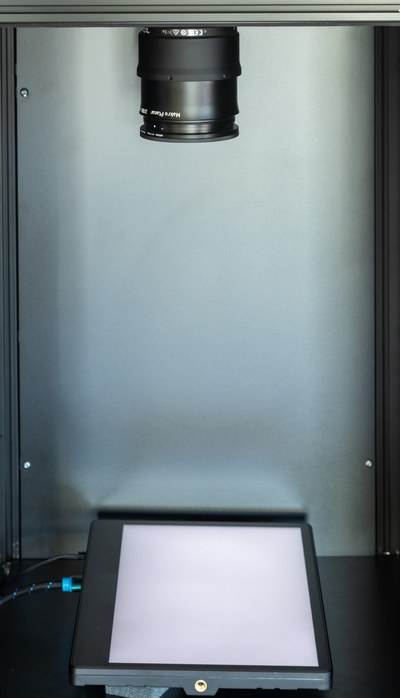
LMK 7 in a measurement setup.
Key Specifications
Photometrics & Calibration — the LMK 7-128 inherits the V(λ)-matched performance characteristics of the LMK 6 family, scaled to the 128 MP platform.
| Technical Data | |
|---|---|
| Sensor — imaging CMOS matrix system | 13 400 × 9 528 — ~128 MP (127.7 MP exact) Sony-CMOS [ IMX661 (APS-C); 12 Bit digital ] |
| Pixel size | 3.45 µm |
| Binning modes | 1×1 (native) to 32×32 |
| Housing dimensions without lenses (H × W × D) | Stable black anodized aluminum housing: 150 × 125 × 125 mm |
| Weight | Camera housing without lens: ~1 800 g |
| Data interface | 10 Gigabit Ethernet (M12 X-coded), Power over Ethernet |
| Metrological data | |
|---|---|
| Dynamic range | Single picture measurement: 1:1100 (~ 61 dB) High-dynamic measure (exposure bracketing series): 1:10,000,000 (~ 140 dB) |
| Spectral matching1 | Matched to the spectral luminous efficiency V(λ) for photopic vision with a full-glass filter |
| Metrological specification | V(λ) [ f1'< 3 %]2 |
| Measuring quantity | Luminance: L (cd/m²) |
| Measuring range³ | 1 ms ≈ max. 10,000 cd/m² 3 s ≈ max. 3.3 cd/m² The detection limit4 (f3,0) for all integration/exposure times is about 0.04 % relative to the given maximum luminance value. Higher luminance can be measured using optional neutral density filters. |
| Calibration uncertainty5 | fix focused lenses ∆L [ < 2% ] focusable lenses ∆L [ < 2.5% ] |
| Repeatability6 | ∆L [ < 0.1% ] |
| Measuring accuracy | ∆L [ < 3%] for standard illuminant A |
| Uniformity4 | ∆L [ < 2% ] |
1 Typical average result for entocentric lenses, specific results available with calibration certification or on request
2 Spectral mismatch f‘1 according to ISO/CIE 19476:2014
3 The luminance value stands for the measuring range end value at the specified exposure/integration time
4 Definition and measurement according to CIE 244:2021
5 Measurements according to CIE 244:2021 using a luminance standard traceable to the PTB (Physikalisch-Technische-Bundesanstalt, the National Metrology Institute of Germany)
6 Measurement performed on a stabilized white LED light source L=100 cd/m² – mean value over 100 × 100 camera image pixel
Software
The LMK 7-128 runs with three dedicated TechnoTeam software suites: LabSoft (lab / R&D), LightChecker (in-line inspection) and DeMura (in-line DeMura correction). LabSoft is scriptable via ActiveX, Python and gRPC; LightChecker and DeMura integrate via TCP/IP.
Request a Consultation or Live Demo
Specifying a DeMura production line, planning an in-line inspection, or comparing LMK models? Our display-metrology team will help you select the right configuration and can arrange a live demo at our Ilmenau facility or on site.
FAQ LMK 7
What is the LMK 7-128 designed for?
The LMK 7 -128 is designed for in-line DeMura correction and high-resolution in-line inspection on production lines. Native mode serves per-emitter luminance measurement on fine-pitch OLED / µLED / Micro-LED panels; binned mode serves as a high-sensitivity imaging photometer for lighting, signage and signal inspection.
How does it compare to the LMK 6 family?
LMK 6 (5, 12, 30 MP, mono or color) covers general-purpose imaging photometry and colorimetry; LMK 7-128 Mono is monochrome-only and higher-resolution, with a primary focus on in-line DeMura. All LMK models are lab- and in-line-capable; the choice depends on resolution, sensitivity and application focus. An application-oriented comparison is on the LMK overview.
Which sensor does it use?
The Sony IMX661 monochrome CMOS sensor with electronic global shutter. See the Key Specifications and the PDF datasheet for details.
What does "two operating modes" mean?
Native read-out delivers the full pixel resolution unbinned (also labelled "1×1" in software menus). Binning combines adjacent pixels into larger, more sensitive superpixels — supported factors are 2×2, 4×4, 8×8, 16×16 and 32×32.
What is APR, and when is it relevant?
APR is TechnoTeam's software workflow for pixel-level measurement on fine-pitch displays, optimised for DeMura production workflows and high-resolution display metrology. APR runs on every LMK as pure software and does not require geometric calibration. Full description: DeMura & Pixel-Level Measurement application page.
How many camera pixels per display pixel are needed?
Without µShaking, aim for ~10 camera pixels per display pixel in each dimension. With the optional internal µShaking, APR extends to ~2–3 cpx/dpx for the same measurement quality. Exact configuration depends on panel size, pitch, working distance and lens — our application team will size the right setup.
Is geometric calibration included?
Photometric V(λ) calibration is standard. Type II calibration (photometric + geometric) is an option for applications requiring absolute positional accuracy. APR itself does not require geometric calibration.
How is the camera powered and connected?
Image data and power share a single M12 X-coded 8-pin connector (10 GbE + PoE). Alternatively, DC power via 20–24 V DC input (see datasheet for the exact power budget). A LEMO connector provides the hardware trigger in/out. Cameras with µShaking additionally carry a HiRose connector for the sensor-stage drive.
Is internal µShaking always included?
No — internal µShaking is an optional factory add-on (not retrofittable). When ordered, the option includes the dedicated HiRose drive cable and is driven by the LMK.
Can it be used on a production line?
Yes — the production line is the primary operational focus. LightChecker software covers in-line inspection; DeMura software covers in-line DeMura correction (both TCP/IP). In addition LabSoft covers lab use (ActiveX, Python, gRPC). The same hardware runs in all three environments, so a measurement developed in the lab can be industrialised on the line without re-qualifying the camera.
Permanent vibrations are critical in my production environment — do I always need to use µShaking?
No. TechnoTeam has developed a patented method that derives pixel-accurate correction data from a single µShaking characterisation — subsequent routine measurements then run without active shaking. For production lines or vibration-sensitive environments, the µShaking sequence can be executed once (for example at line setup or per-product teach-in), after which the in-line measurement proceeds shake-free with the correction data applied. For setups with sufficient native sampling (~10 camera pixels per display pixel), APR works well on its own and µShaking is not required at all.
- Type:
- Hardware
- Applications:
- Automotive Display
- Measurands:
- Light measurement
- Tasks:
- Automation & Industry Development & Industry