NED Lenses with Liquid Lens Focus for AR/VR/MR Display Testing
Inspired by the human eye – The LMK EyeFit Lens series
LMK EyeFit is a lens series specially developed for NED measurements. The LMK EyeFit lens design — covered by TechnoTeam's international patent family (e.g. DE 10 2023 113 210 B3) — uses a liquid lens based focus mechanism that mimics the accommodation process of the human eye. When combined with a LMK 6-30 imaging photometer/colorimeter, it delivers enhanced image quality and a diffraction limited MTF outperforming most standard NED lenses that rely on a conventional mechanical focus mechanism. The different focal lengths are optimized for different measurement tasks for efficient and standard-compliant AR, VR and MR display testing.
SEE IT WITH YOUR OWN EYES
LMK EyeFit – Features at a Glance
- Liquid lens focus from -10 dpt to +10 dpt
- No shift in the entrance pupil position during focusing
- No mechanical movements
- Diffraction-limited MTF (see technical data below)
- Compact design enables eye rotation movements
- Custom external entrance pupils (between 2 mm and 6 mm)
- Custom addition of neutral density filters
- Compliant with IEC 63145 and IDMS 1.3 Chapter 19
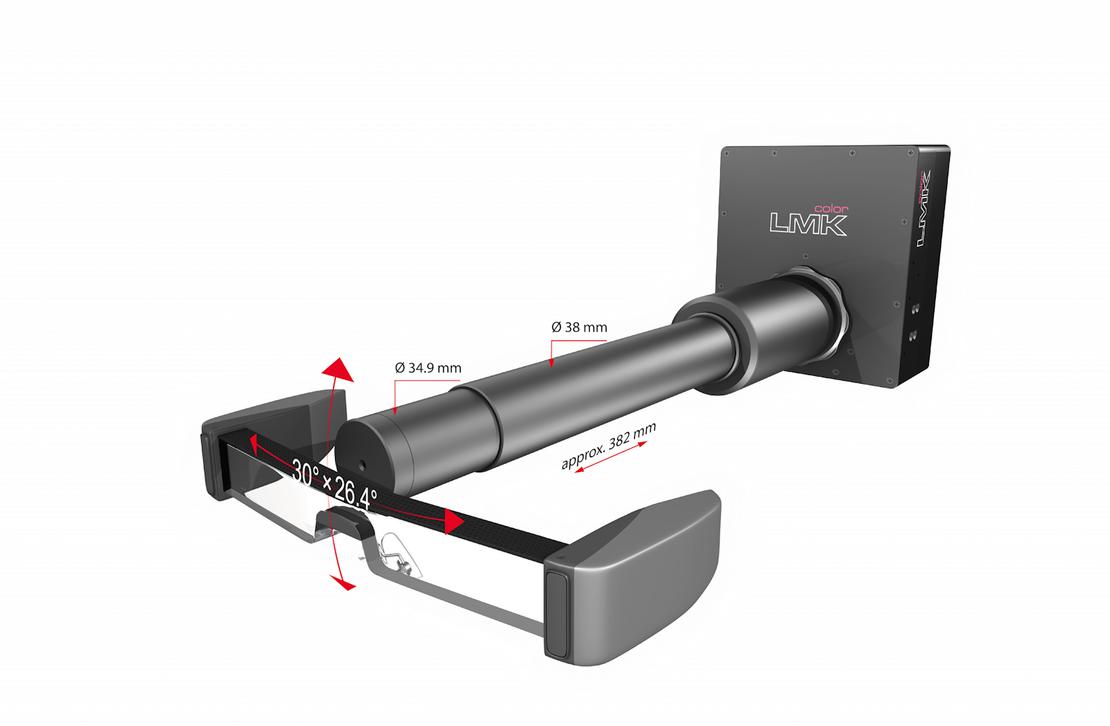
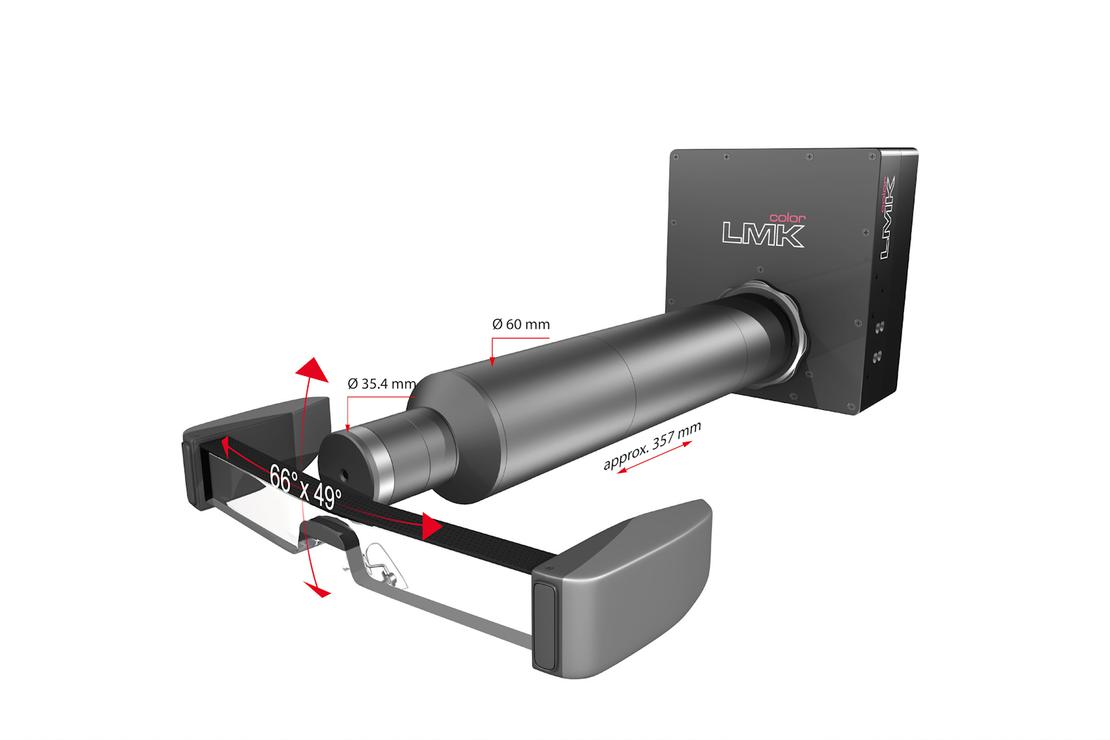
Technical data
| Lens type | TTNED-40-AFS | TTNED-40-AFL | TTNED-17-AF |
|---|---|---|---|
| Focus operation | Electronically controlled focus | Electronically controlled focus | Electronically controlled focus |
| Focal length | 40 mm | 40 mm | 17 mm |
| Focal power | -5 dpt to +10 dpt | -5 dpt to +10 dpt | -10 dpt to +10 dpt |
| Focus distance | > 100 mm to infinity | > 100 mm to infinity | > 100 mm to infinity |
| Entrance pupil position | at position of the aperture cap | at position of the aperture cap | at position of the aperture cap |
| Entrance pupil diameter | 2 – 6 mm pinhole diameter of the aperture cap | 2 – 6 mm pinhole diameter of the aperture cap |
2 – 5 mm pinhole diameter of the aperture cap |
| Field of view (LMK 6-30) | ±15° (H) × ±12.8° (V) | ±15° (H) × ±13.1° (V) | ±33° (H) × ±24.5° (V) |
| Field of view (LMK 6-12) | ±10.2° (H) × ±7.7° (V) | ±10.6° (H) × ±7.3° (V) | ±20.2° (H) × ±15.3° (V) |
| Field of view with diffraction limited* MTF for 2 mm entrance pupil | ±14° |
±10° |
±30° |
| Field of view with diffraction limited* MTF for 3 mm entrance pupil | ±9.5° | ±7.4° | ±9.5° |
| Field of view with diffraction limited* MTF for 4 mm entrance pupil | ±6.2° | ±2.5° | ±2.0° |
| Field of view with diffraction limited* MTF for 5 mm entrance pupil | ±3.8° | ±1.0° | not diffraction limited |
| Field of view with diffraction limited* MTF for 6 mm entrance pupil | ±2.4° | not diffraction limited | not available |
| Imaging resolution | 195 cpx/deg | 191 cpx/deg | 98 cpx/deg |
| Length of lens body | 64 mm | 382 mm | 357 mm |
| Diameter of lens body | 35 mm at entrance pupil position
60 mm at widest position |
35 mm at entrance pupil position
60 mm approx. 198 mm behind lens tip |
35.4 mm at entrance pupil position
60 mm approx. 58 mm behind lens tip |
| Lens | Technical specifications |
|---|---|
| TTNED-40-AFS | Focus operation: Electronically controlled focus Focal length: 40 mm Focal power: -5 dpt to +10 dpt Focus distance: > 100 mm Entrance pupil position: at position of the aperture cap Entrance pupil diameter: 2 – 5 mm pinhole diameter of the aperture cap Field of view: ±15° (H) × ±12.8° (V) (LMK 6-30); ±10.2° (H) × ±7.7° (V) (LMK 6-12) Field of view with diffraction limited* MTF for 2 mm entrance pupil: ±14° Imaging resolution: 195 cpx/deg Length of lens body: 64 mm Diameter of lens body: 35 mm at entrance pupil position | 60 mm at widest position |
|
TTNED-40-AFL |
Focus operation: Electronically controlled focus Focal length: 40 mm Focal power: -5 dpt to +10 dpt Focus distance: > 100 mm to infinity Entrance pupil position: at position of the aperture cap Entrance pupil diameter: 2 – 6 mm pinhole diameter of the aperture cap Field of view: ±15° (H) × ±13.1° (V) (LMK 6-30); ±10.6° (H) × ±7.3° (V) (LMK 6-12) Field of view with diffraction limited* MTF for 2 mm entrance pupil: ±10° Imaging resolution: 191 cpx/deg Length of lens body: 382 mm Diameter of lens body: 35 mm at entrance pupil position | 60 mm approx. 198 mm behind lens tip |
| TTNED-17-AF | Focus operation: Electronically controlled focus Focal length: 17 mm Focal power: -10 dpt to +10 dpt Focus distance: > 100 mm to infinity Entrance pupil position: at position of the aperture cap Entrance pupil diameter: 2 – 6 mm pinhole diameter of the aperture cap Field of view: ±33° (H) × ±24.5° (V) (LMK 6-30); ±20.2° (H) × ±15.3° (V) (LMK 6-12) Field of view with diffraction limited* MTF for 2 mm entrance pupil: ±30° Imaging resolution: 98 cpx/deg Length of lens body: 357 mm Diameter of lens body: 35.4 mm at entrance pupil position | 60 mm approx. 58 mm behind lens tip |
*Diffraction-limit definition: Strehl ratio >0.9 for V(λ)-weighted spectra and 0 dpt focus (infinity)
FAQ — LMK EyeFit
LMK EyeFit is a lens series specially developed for NED (near-eye display) metrology. It combines a calibrated, external entrance pupil at the lens tip (interchangeable aperture caps; 2–6 mm depending on model) with an electronically controlled, liquid lens-based focus mechanism that mimics the accommodation of the human eye. Combined with a type II-calibrated LMK 6-30 or LMK 6-12 imaging photometer/colorimeter, the EyeFit lenses cover AR, VR and MR display testing in compliance with IEC 63145 and IDMS 1.3 chapter 19. The series includes three variants with electronically controlled liquid lens focus — TTNED-40-AFS, TTNED-40-AFL and TTNED-17-AF.
The focus mechanism of an NED metrology lens needs to keep the size and position of the entrance pupil, as well as the other optical parameters of the lens — geometric distortion and optical resolution — stable across the full focus range. A standard mechanical focus moves optical groups along the optical axis and can change exactly these properties: geometric distortion, optical resolution, and the position and size of the entrance pupil. The liquid lens avoids this by changing the radius of curvature of an optical element instead of moving anything. The result is a focus range from −10 dpt to +10 dpt — without entrance-pupil shift and without mechanical movement in the focus path.
The human eye changes focus by changing the shape of the crystalline lens; the EyeFit liquid lens does something very similar and adjusts the radius of curvature of an optical element. In both cases the entrance/exit pupil stays in place. NED measurement standards (IEC 63145, IDMS 1.3 chapter 19) define the measurement relative to the eye-point inside the eyebox — with a small aperture matching the human pupil at exactly that point. A lens that can change focus without shifting its entrance pupil therefore reproduces what a human observer sees across the entire focus range.
IEC 63145 and IDMS 1.3 chapter 19 require the entrance pupil of the ILMD to sit at the eye-point inside the eyebox, with a defined aperture diameter. Every measurement is referenced to that position. If the entrance pupil drifts during focusing — as it does with most mechanically focused lenses — every focus change introduces an undefined offset between the entrance pupil and the eye-point, and precise alignment becomes impossible. A stable entrance-pupil position across the entire focus range is also the basis for the fast, focus-based alignment workflow.
Most standard lenses have their entrance pupil inside the lens housing. For NED metrology, this is a problem. The entrance pupil of the measurement system must be physically positioned inside the eyebox of the headset — a location that a standard lens cannot reach. Two design strategies solve this problem. The front-stop lens places a physical aperture stop at the lens tip — clearly defined entrance-pupil position and a mechanically accessible pupil.
If an internal aperture of a lens is imaged in front of the lens, this virtual aperture image forms the entrance pupil. This way more mechanical clearance is created at the lens tip.
The EyeFit series uses the front-stop principle with calibrated, interchangeable aperture caps. The TTNED-17-AF additionally supports a virtual entrance pupil configuration. The aperture is projected in front of the lens tip, which increases the distance between the entrance pupil and the last physical surface of the lens. In this configuration, the pupil size can no longer be changed, but the position of the virtual pupil in front of the lens can be configured per application — at the cost of field of view.
A virtual entrance pupil design projects the optical aperture in front of the lens tip. The operator places that virtual entrance pupil into the eyebox of the headset, while the first optical surface of the lens stays behind the eye-point of the headset. This gives more mechanical clearance and a longer effective measurement distance. The cost is geometric: the further out the virtual entrance pupil sits in front of the lens tip, the narrower the bundle of rays accepted by the optic gets — and the smaller the achievable field of view.
The configuration is therefore chosen per application: maximum FoV → physical front stop; maximum measurement distance or mechanical access → virtual entrance pupil.
The diameter of the human pupil depends on the adaptation state and ranges from roughly 2 mm (photopic, daylight adaptation) to about 5–6 mm (scotopic, dark adaptation). The aperture of an NED metrology lens has to cover exactly this range, because the eyebox of an NED is small and the relevant photometric quantities — luminance, contrast, vignetting, chromaticity — can change rapidly across it. A measurement aperture that does not match the human pupil would integrate over the wrong solid angle and miss those local variations.
Two further constraints follow from the photometry of the luminance camera:
- Aperture filling: The absolute luminance calibration is only valid if the entrance pupil of the ILMD is fully filled with light from the NED's exit pupil. A 4 mm exit-pupil NED can therefore be measured with a 2 mm ILMD entrance pupil but not with a 5 mm entrance pupil — the calibration would become invalid.
- Calibration consistency: Each aperture cap is calibrated individually, so all apertures in the 2–6 mm range remain photometrically traceable.
In photometric measurements, the relative size of the source aperture (the NED's exit pupil) and the receiver aperture (the entrance pupil of the ILMD at the EyeFit aperture cap) defines two conditions:
- Overfill — the source aperture is at least as large as the receiver aperture. The receiver is fully illuminated, and the absolute luminance calibration of the ILMD remains valid.
- Underfill — the source aperture is smaller than the receiver aperture. Only the central part of the receiver gets light from the source, and the calibration becomes invalid.
For EyeFit lenses, the underfill case has to be avoided: the chosen aperture cap must be at most as large as the NED's exit pupil. Example: a 4 mm exit-pupil NED can be measured with a 2, 3, or 4 mm aperture cap (overfill); a 5 or 6 mm cap leads to underfill and therefore to an invalid calibration.
This aperture-filling rule is one of the photometric foundations of IEC 63145 and IDMS chapter 19.
- TTNED-17-AF — 17 mm focal length, 357 mm lens length
- Widest field of view (±33° H × ±24.5° V), 98 cpx/deg
- Supports both physical and virtual entrance-pupil configurations
- Optional folded (bent) optical path — moves the camera housing out of the direct DUT axis, keeping it accessible even in tight DUT envelopes [Schramm2025-CIE]
- Long, slim build — good reach into the eyebox, suitable for eye-rotation movements
- TTNED-40-AFL — 40 mm focal length, 382 mm lens length
- Higher angular resolution (191 cpx/deg) than the 17-AF
- Same long, slim form factor as the 17-AF
- Suitable for measurements that require higher angular resolution (more cpx/deg detail) while still needing reach into the eyebox and free rotation
- TTNED-40-AFS — 40 mm focal length, 64 mm lens length
- Best MTF performance in the series and very high angular resolution (195 cpx/deg)
- Compact lens housing brings the camera close to the device under test (DUT)
- Ideal for component-level measurements where mechanical access around the DUT is not critical
The LMK EyeFit lenses are compatible with both the LMK 6-30 and the LMK 6-12 — both image-resolved photometer / color measurement cameras. The tables on the product page list field-of-view and angular-resolution figures for both cameras across all three lens variants (TTNED-17-AF, TTNED-40-AFS, TTNED-40-AFL).
Standard options:
- Interchangeable, individually calibrated aperture caps with pupil diameters from 2 mm to 6 mm in 0.1 mm steps.
- Aperture caps with built-in, individually calibrated neutral-density (ND) filters (optical density 0.9 to 3.0).
TTNED-17-AF-specific options:
- Optional virtual entrance pupil configuration — larger free working distance at the cost of a smaller flat-field of view.
- Folded optical path (90° bend) — alternative access route to the exit pupil of the device under test in case of mechanical constraints; useful for fully assembled AR/VR headsets where the camera housing would not fit between the headset's temples [Schramm2025-CIE].
Further configurations on request:
- Intra-lens spectrometer integration for high-precision, SMCF-corrected color measurements through the same optics as the ICMD [Schramm2025-CIE].
In a classical incoherent imaging chain, the measured MTF of the DUT can be approximated as a cascade of the DUT MTF and the MTF of the optical metrology system. The contribution of the metrology system can then be removed from the result by dividing through the system MTF. For NEDs, this approximation breaks down: a phase coupling arises between the NED and the NED metrology lens, so the simple cascade rule no longer holds. A direct correction of the measurement data is therefore only possible if the NED metrology lens itself is diffraction-limited (or very close to it) at the relevant spatial frequencies. In that regime, the lens contribution is well-defined.
The diffraction-limited field of view for each lens/aperture combination is listed in the technical-data table. This requirement is NED-specific — for flat-panel displays, see our LMK Display Resolution add-on.
The foveal acuity of the human eye reaches up to 90–100 line pairs per degree (lpd); at a retinal eccentricity of 10°–20°, it drops to about 30–40 lpd [Ashraf2025-NatComm]. To reliably resolve a spatial frequency of f lp/deg, the combination of camera and lens has to sample at least at 2f cpx/deg (Nyquist). With an LMK 6-30 or LMK 6-12, the EyeFit lenses reach 195 cpx/deg (TTNED-40-AFS), 191 cpx/deg (TTNED-40-AFL), and 98 cpx/deg (TTNED-17-AF) — the 40 mm lenses are therefore well above Nyquist in the foveal range, and the TTNED-17-AF is well-suited for off-axis and wide-angle measurements. The lenses are diffraction-limited across the field-of-view range that matters for the 10°–20° eccentricity, so the corresponding 30–40 lpd acuity range can be measured directly.
A type II ILMD is calibrated in two complementary aspects.
The first aspect is a photometric calibration (Type I) per CIE 244:2021: it maps each pixel value to an absolute luminance. The TechnoTeam LMK color achieves an overall photometric uncertainty below 2.5 % and a repeatability below 0.1 %. In addition, the spectral responsivity of each LMK camera — and of each LMK + EyeFit lens combination — is characterised.
The second aspect is a geometric calibration with two components. The angular calibration assigns a defined viewing direction relative to the entrance pupil to every sensor pixel — the prerequisite for F-Theta or F-Tan-Theta distortion correction. The focus-to-distance mapping of the liquid lens additionally makes the Virtual Image Distance (VID) accessible.
Together, both aspects are the foundation of the fast alignment, exit-pupil localisation, boresight measurement, and VID workflows that EyeFit supports.
Focus range by model:
- TTNED-17-AF: −10 dpt to +10 dpt; focus distance > 100 mm to infinity.
- TTNED-40-AFS / -AFL: −5 dpt to +10 dpt; focus distance > 100 mm to infinity.
All three liquid-lens variants share the same near-focus limit (> 100 mm to infinity); they differ only at the negative end of the diopter range. A note on the diopter scale: 0 dpt corresponds to focus at infinity; positive values focus closer (close-up), negative values place the focus "beyond infinity".
Three measurement scenarios benefit from a wide range:
- Virtual image distance (VID) measurement — the VID of an NED can be a test parameter and typically requires coverage from around 500 mm to infinity.
- Correction-lens scenarios — clip-in corrections for myopia or hypermetropia in an NED shift the virtual image beyond the infinity setting. This is exactly what the negative diopter branch is for (e.g. −5 dpt), which only becomes accessible because focus can go past 0 dpt = infinity.
- Eye-point alignment and eyebox measurement — some alignment workflows focus on the exit pupil of the NED itself instead of the virtual image, which requires near distances of only a few centimetres.
In NED metrology, two distortion metrics are practically relevant:
- F-Theta distortion — deviation from an ideal equidistant angular resolution (camera pixels per degree).
- F-Tan-Theta distortion — deviation from an ideal equidistant spatial resolution (camera pixels per mm).
A lens cannot be optimised for both at the same time. The liquid-lens-based NED lenses are designed for low F-Theta distortion across the entire focus range; for measurements that require low F-Tan-Theta distortion, the correction data is derived from the type II calibration. For the TT-NED 40 mm, the focus dependence of the F-Theta distortion is around 0.15 % between infinity and 5 dpt; the typical residual error after distortion correction is below 8 pixels (≈ 0.04°).
Liquid lenses are occasionally associated with limited focus reproducibility — due to gravity effects, hysteresis, or temperature sensitivity. The EyeFit design counters this with two main measures: gravity compensation (the liquid lens responds to its orientation; horizontal setups are the worst case) and/or a deliberate restriction of the liquid lens to its paraxial region.
The resulting reproducibility was validated experimentally: over 48 hours, around 3400 MTF measurements were taken at a focus distance of 400 mm in two configurations — in the stability test, the focus is set once to 400 mm and only the MTF is repeatedly captured; in the reproducibility test, the focus is randomly changed and reset to 400 mm before each MTF measurement. The MTFs are practically identical in both experiments and show only minor variations at higher frequencies. The sensitivity of this test is high: with the TTNED-40-AFS, a diopter change of as little as 0.011 dpt can be detected at a focus distance of 400 mm. The fact that the MTF variations across the full 48-hour window remain small therefore demonstrates very good focus stability.
Mechanical design measures together with this end-to-end validation of stability and reproducibility are what make liquid-lens-based NED metrology reproducible in practice.
Three international standards form the backbone of the EyeFit qualification chain:
- CIE 244:2021 — Characterisation of imaging luminance measurement devices (ILMDs); basis for Type I and Type II calibration as well as the stray-light performance values f₂₄ and f₂₅.
- ISO 17850:2015 — Photography — Digital cameras — Geometric distortion (GD) measurements; used to validate the geometric calibration of the EyeFit lens (F-Theta / F-Tan-Theta distortion correction).
- ISO 12233:2024 — Photography — Electronic still picture imaging — Resolution and spatial frequency responses; slanted-edge method for MTF and resolution, evaluated in tangential and sagittal (or alternatively horizontal and vertical) directions, at different entrance-pupil diameters and field positions.
The NED-specific application standards remain IEC 63145 and IDMS 1.3 chapter 19.
Yes. ILMD stray light is characterised via the CIE performance values f₂₄ and f₂₅ (CIE 244:2021). The EyeFit lenses can be delivered with an optional stray-light calibration that — on top of the standard ILMD calibration — roughly doubles the measurable contrast according to f₂₄ and f₂₅. This is particularly relevant when high-contrast test patterns such as checkerboards are used on AR/VR/MR devices.
Several procedures exist for eye-point alignment. The reference procedure is described in IDMS chapter 19, subsection 19.3.2 — lateral scanning through the eyebox, typically around 30 captures per device at 0.5 mm step size. Combined with a type II calibration, the EyeFit lens enables a faster, equivalent variant: focus on the eyebox provides the Z-distance via the focus-to-distance mapping, the angular calibration provides the X/Y direction — a single motion moves the ILMD to the eye-point. The method, validation against the IDMS reference, and the achieved positioning accuracy are described in [Kirchhoff2026-SPIE].
Yes. The same focus-based positioning principle also locates the exit pupil of an AR projector and measures its boresight angle — the angular deviation between the mechanical reference axis of the projector and the optical axis of the projected virtual image. The detailed workflow — exit-pupil localisation via focus search on the waviness of the exit-pupil luminance profile, positioning of the entrance pupil at the projector's exit pupil, and boresight measurement via the photometric centre of the virtual image — is described in [Kirchhoff2026-SPIE].
For eye-rotation measurements, the ILMD has to rotate around the eye rotation centre, which lies about 10 mm behind the entrance pupil [Webpage-NED-App]. During rotation, the lens tip also moves — but, due to its proximity to the rotation centre, only minimally. The camera housing and the rear end of the lens (around 60 mm in diameter), by contrast, have a noticeably longer lever arm and trace a correspondingly larger arc. For the camera housing to clear the outer contour of the headset at every rotation angle, the lens has to be long and slim so that the relatively bulky camera housing remains well behind the headset.
This geometry favours the TTNED-17-AF (357 mm lens length) and the TTNED-40-AFL (382 mm). The compact TTNED-40-AFS (64 mm) brings the camera housing close to the headset — in tight setups this can cause collisions at large rotation angles; with sufficient mechanical clearance around the DUT, the AFS is unproblematic.
The rotation motion is realised mechanically — e.g. via goniometers, translation stages, hexapod or industrial robots such as LMK Position.
A type II-calibrated LMK 6 color (filter-wheel ICMD) offers excellent spectral matching to the CIE 1931 standard observer. The tristimulus method additionally benefits from a Spectral Mismatch Correction Factor (SMCF) per CIE 179:2007. The SMCF is computed from two inputs: a spectral measurement of the DUT via the spectrometer, and the spectral responsivity of the specific NED metrology system in use (the combination of LMK camera and EyeFit lens). For exactly this purpose, the spectral responsivity of each LMK camera — and of each LMK + EyeFit lens combination — is captured as part of our calibration. Both inputs together further improve color accuracy — especially in the critical luminance ranges of NEDs (narrow-band RGB emitters, OLED/MicroLED) [Schramm2025-CIE].
When the spectrometer needs to measure through the same optics as the ICMD — e.g. to capture exactly the same 2° on-axis field as the standard observer without mechanical re-alignment — the intra-lens spectrometer design from [Schramm2025-CIE] integrates the spectrometer port via a beam splitter into a conoscopic NED lens with liquid-lens focus. For project-specific configurations, feel free to contact us.
Yes. Microscope eyepieces, camera viewfinders, telescope eyepieces, and similar near-eye visual instruments share the same optical architecture as NED systems: they generate a virtual image that the user observes through a small exit pupil at a defined eye-point. The metrological requirements are the same — a measurement aperture matching the human pupil (2–6 mm), the entrance pupil at the eye-point inside the exit pupil, and a focus range that covers the observer's accommodation. The EyeFit lenses meet all of these requirements and can be used directly to characterise such instruments — with the same hardware and the same calibration chain as for NED measurements.
RELEVANT PRODUCTS AND APPLICATIONS

Publications
AR | VR | MR, 2026, Proceedings Volume 13821, Optical Architectures for Displays and Sensing in Augmented, Virtual, and Mixed Reality (AR, VR, MR) VII; 138210F (2026)
CIE Midterm Meeting Vienna, Austria 2025
SID Vehicle Displays & Interfaces 2022
Information Display
International Conference on Display Technology (ICDT 2019)
- Type:
- Optical component
- Applications:
- Automotive Aviation Display Human Centric Lighting
- Measurands:
- Light measurement
- Tasks:
- Development & Industry Science & Research